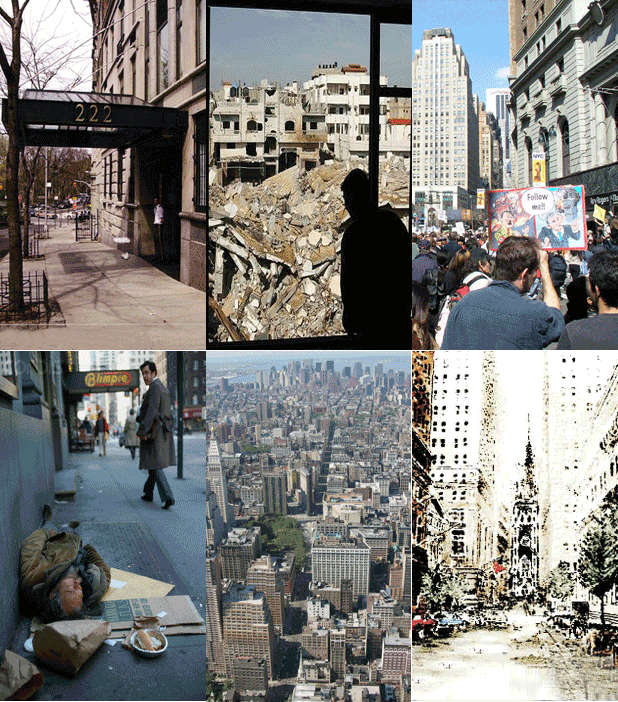
Sound Bite
A Bird in the Bush shows how BushÃ??'s initiatives fit within a framework of conservative Republican thinking that reaches back to the Nixon era, and then shows how various individual policies have failed to meet their purported goals and the votersÃ??' expectations.
About the Author
Dowling Campbell, Professor Emeritus at Northern Arizona University, has put together this collection of views from professors around the country.
|
|
About the Book
In this collection of essays the authors, professors of history and political science at US colleges and universities, analyze George W. Bush's record on domestic issues ranging from women's rights to the environment, power, transportation,...
In this collection of essays the authors, professors of history and political science at US colleges and universities, analyze George W. Bush's record on domestic issues ranging from women's rights to the environment, power, transportation, taxes, abortion, education, welfare, healthcare, homeland security, and employment. The need for A Bird in the Bush: Failed Domestic Policies of the George W. Bush Administration was sparked by what many informed and responsible Americans have seen as serious blunders committed by President George W. Bush, even during his first term of office. Especially troublesome was the 2005 Inaugural Address. This second inaugural address illustrates how Ã??'Bush IIÃ??' is derailing the purpose of America as a nation. Bush II could not perform this derailing all on his own. He had help. Both the introduction and the lead article, Ã??'The Height of Folly,Ã??' present a framework of Republican activities covering a wide range of conservative thinking reaching back to the Nixon era. The remaining articles then show how various additional individual policies have failed.
|
The need for A Bird in the Bush: Failed Domestic Policies of the George W. Bush Administration was sparked by what many informed and responsible Americans have seen as serious blunders committed by President George W. Bush during his first term of office. Especially troublesome is the 2005 Inaugural Address. This second inaugural address...
The need for A Bird in the Bush: Failed Domestic Policies of the George W. Bush Administration was sparked by what many informed and responsible Americans have seen as serious blunders committed by President George W. Bush during his first term of office. Especially troublesome is the 2005 Inaugural Address. This second inaugural address illustrates how Ã??'Bush IIÃ??' is derailing the purpose of America as a nation. (It is analyzed in the introduction.) Bush II could not perform this derailing all on his own. He had help. Both the introduction and the lead article, Ã??'The Height of Folly,Ã??' present a framework of Republican activities covering a wide range of conservative thinking reaching back to the Nixon era. The remaining articles then show how various additional individual policies have failed. It is this conservative thinking that has undermined the roadbed and allowed for Bush IIÃ??'s distortion of the nationÃ??'s avowed stand for freedom and democracy. The perspective of Republican activities also helps show why various Bush II policies that many see as blunders have been able to go unchallenged. Hopefully, this book will succeed in informing voters where other media have failed. The intensity of the media, the demands of television time, along with the limited space and hence brevity of magazine and newspaper articles and editorials are three informational limitations which dictate that commentators and analysts must be too brief to even approach an adequate presentation of information for voters to vote intelligently, even when those commentators and analysts have valid points and arguments. It doesnÃ??'t matter how much you know, if that knowledge does not get across to voters. Other books have attempted to describe these informational limitations. Neil PostmanÃ??'s Language in America rings as relevant today as it did when it pointed out the problem of media intensity four decades ago. Three decades ago, Alvin Toffler described the problem of time crunching in Future Shock. James Gleick has reiterated both media intensity and time crunch dilemmas in his book, FSTR: Faster, the Acceleration of Just about Everything. Books themselves, with their more deliberate and hopefully more cognitive and in-depth research capabilities, are no panacea, either. Special interests, personal prejudices, religious leanings, and outright dishonesty can slant books just as easily as they do other media programs and presentations. Also, books are just as susceptible to logical fallacies and propaganda devices as other media forms are. The writers represented in A Bird in the Bush: Failed Domestic Policies of the George W. Bush Administration have attempted accuracy and honesty, above all else. I am most grateful to all the scholars who have contributed so generously of their time, talent, and yeoman effort, to say nothing of their love for and dedication to their country, in preparing these articles. They join me in one of the most patriotic efforts imaginable Ã??' responsible, constructive, and caring criticism of our government. When Vice President Dick Cheney and Attorney General John Ashcroft intimate that critics of the Bush II administration are committing treason (the same argument was made during the Nixon and Reagan presidencies), they need to recall a statement from The Arrogance of Power, written by one of AmericaÃ??'s and the worldÃ??'s most distinguished thinkers, the late Sen. J. William Fulbright. Fulbright not only approved such dissent but called it a duty. Unfortunately, this duty promotes anger from the targets of that criticism, which can result in threats from them and create fear among the public. Ã??'The discharge of the duty [FulbrightÃ??'s italics] of dissent is handicapped in America by an unworthy tendency to fear serious criticism of our government.Ã??' (p. 27) This Ã??'threat and fearÃ??' process was once again illustrated by Bush when he contended that those politicians who opposed his social security legislation would be sorry.
|
Chapter 1. George W. Bush and Reproductive Health and HIV/AIDS Policy by John Kemoli Sagala and Zachary A. Smith Northern Arizona University
Chapter 1. George W. Bush and Reproductive Health and HIV/AIDS Policy by John Kemoli Sagala and Zachary A. Smith Northern Arizona University Chapter 2. Environmental Unilateralism: The Bush Administration's Withdrawal from the Kyoto Protocol on Global Warming by Sayuri Guthrie-Shimizu Michigan State University Chapter 3. Bush and the Environment by Jaina L. Moan and Zachary A. Smith Northern Arizona University Chapter 4. Bush Fiscal Policy: The Short and the Long of It. by Don Rich Chapter 5. The Bush Administration's Campaign against the International Criminal Court by Douglas Becker Colgate University Chapter 6. Nationalism as the New Cultural Issue by Jerry F. Hough Duke University Chapter 7. Policies of the George W. Bush Administration Ã??' the Height of Folly by Dowling G. Campbell
|
More . . .
Contributors: Douglas J. Becker, University of Southern California Dowling G. Campbell, Northern Arizona University Sayuri Guthrie-Shimizu, Michigan State University Jerry Hough, Duke University Jaina L. Moan, Northern Arizona University Don Rich, Delaware and Montgomery County Community Colleges John Kemoli Sagala, Northern Arizona University Zachary Smith, Northern Arizona University
Contributors: Douglas J. Becker, University of Southern California Dowling G. Campbell, Northern Arizona University Sayuri Guthrie-Shimizu, Michigan State University Jerry Hough, Duke University Jaina L. Moan, Northern Arizona University Don Rich, Delaware and Montgomery County Community Colleges John Kemoli Sagala, Northern Arizona University Zachary Smith, Northern Arizona University
|
|
Pages 228
Year: 2005
LC Classification: E902.B555
Dewey code: 973.931Ã??'dc22
BISAC: HIS036070
BISAC: POL017000
BISAC: POL040010
Soft Cover
ISBN: 978-0-87586-340-5
Price: USD 22.95
Hard Cover
ISBN: 978-0-87586-341-2
Price: USD 29.95
Ebook
ISBN: 978-0-87586-342-9
Price: USD 22.95
|