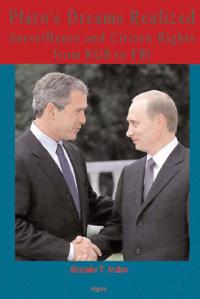
Sound Bite
Alexander Avakov briefly shares his personal experiences, first in the Soviet Union with the KGB and then with the American national security state, outlines various ways in which surveillance of citizens is increasing, then examines the bases of our expectations of liberty, from Plato to the US Constitution.
America, he shows, declared high-minded legal ideals but has consistently cheated in their implementation. There is logic, tradition, and a stable modus operandi in the way the American security apparatus violates the Constitution. This book analyzes this socio-pathology of law in the U.S. with regard to national security beliefs.
About the Author
Alexander V. Avakov was born in the USSR. Interested in economic statistics since childhood, he accomplished his formal university education in mathematics and mathematical economics with additional studies in economics, philosophy, law, politics, anthropology, sociology and psychology.
As a result of early political maturity he was arrested in 1975 for distributing liberal-minded leaflets at the university. Sentenced to a year and half of hard labor, he was sent to a KGB-run camp for political prisoners. After completing the prison term, he emigrated from the Soviet Union and has since settled with his family in the United States.
Mr. Avakov has published several books with Algora, including Plato’s Dream Realized: Surveillance and Citizen Rights, from KGB to FBI, and a variety of statistical studies analyzing the relative power of nations in terms both economic and military, including undeclared nuclear weapons. Previously published books in Russian include, among others, Autobiography of the Soviet Anti-Soviet Philosopher, and Welcome to the New Security State.
|
|
About the Book
American democracy is still a model admired around the world, but many Americans and new arrivals alike are shocked by the extent to which the American security apparatus violates the Constitution. This book explores the frontiers of legal theory...
American democracy is still a model admired around the world, but many Americans and new arrivals alike are shocked by the extent to which the American security apparatus violates the Constitution. This book explores the frontiers of legal theory within the United States with regard to modern surveillance and its effects on human rights. The author shares his personal experiences, first with the KGB and then with the US national security state. This second experience helped him realize the dangers of the routine abuses committed by the US intelligence apparatus.
He gives an overview of documents he was able to receive pursuant the Freedom of Information Act mostly blacked out, although they describe his own suspicious activities, i.e. letter-writing. He broadens the discussion to address the wider issue of electronic surveillance by the government. Former CIA and FBI director William Webster describes the agencies use of spiderweb electronic surveillance against "foreign agents" with breathtaking directness.
Avakov then examines the art of electronic surveillance as well as the extent of modern total surveillance, with a consideration of the impact of electronic surveillance on rights, and the philosophical basis for the connection between rights and privacy.
Without privacy, there is no autonomy of person; without autonomy of person, there is no freedom. Yet the United States government employs several legal mechanisms, especially against foreign intelligence agents, which hinge on innovative uses of electronic surveillance. Such techniques include the use of friendly countries intelligence services and Echelon to avoid the ticklish problem of obtaining warrants.
The information collected by the Foreign Intelligence Surveillance Court (FISC) used to be barred from presentation in criminal court as evidence, because it entailed a much weaker probable cause requirement than domestic surveillance. However, developments in connection with the war on terror, such as the USA Patriot Act, allow the US government use of FISC surveillance information for criminal persecution. The resultant weakening of the exclusionary rule and due process in general violate the Constitution.
The history of political spying in the US, as well as warnings by US legal authorities, point to the dangers of electronic surveillance to human rights.
The author concludes with a discussion of practical solutions to counter these dangers as suggested in a number of publications.
By way of background, Avakov adds an extensive reading list giving some sense of the breadth of knowledge pursued by an intellectual of international caliber.
Dr. Avakov is also author of a yearbook of economic and military statistics, Quality of Life, Balance of Power, and Nuclear Weapons. Quality of Life, Balance of Power, and Nuclear Weapons.
|
INTRODUCTION: THE SPELL OF PLATO 1 1. The Subjective: Us Intelligence Greets A Soviet Dissident 3 Introduction: The FBI Was Interested In Me
INTRODUCTION: THE SPELL OF PLATO 1 1. The Subjective: Us Intelligence Greets A Soviet Dissident 3 Introduction: The FBI Was Interested In Me 3 Family And Childhood 3 Youth: Enthusiasm For Economics And Philosophy 5 At The University: Yura Yudkevich Refuses To Take The Military Oath Of Allegiance 5 Leaflets: Psychological Motivator And Convictions 6 Commentary On The Leaflets 8 Investigation And Trial. Encounter With The Committee For State Security (KGB) 10 At The Camp: My Horizons Expand 12 After Camp: A More Dangerous And More Interesting Life 14 Life in the Us: We Are Reaganites 16 Life After 1987 17 What s Next? 17 2. Is There a Problem of Rights Vs. The National Security State in America? 19 2.1 In Lieu of an Epigraph 19 2.2 Myth and Reality 20 A Political Refugee as an Object of the Attention of US Intelligence 20 A Myth Existing Outside of the USA 20 Freedom of Information/Privacy Act 20 The Request to the Washington Headquarters of the FBI 20 What Does Disloyal Person Mean? 21 The Request to the Local Organization of the FBI 22 The Appeal to the FBI 22 The Request to the CIA 22 The Role of the CIA 22 2.3 Why Is There A Question About Electronic Surveillance? 24 Practical Side of the Issue 24 Spiderweb 24 Missing Pages 25 A Phantom Court 25 Innovative Surveillance Methods Used by the Government 26 Did September 11 Render Human Rights Concerns Obsolete? 26 What is in Dispute 30 We Do Not Recognize What is in Front of Us 30 Meltdown 31 2.4 Political Spying in the Us 32 Dynamics of Political Spying 32 Transgressions of the 18th Century 33 Undercover Surveillance in the 19th Century 33 Undercover Surveillance in the Beginning of the 20th Century 34 Emergence of Organized Political Spying 35 The Intelligence Culture 39 Rationale for Political Spying 40 Political Spying since the Outset of the Cold War 42 Political Spying in the 1950s 44 Political Spying in the 1960s 47 Political Spying in the 1970s 51 Political Spying in the 1980s 56 Political Spying in the 1990s 59 Political Spying and Rights in the 2000s 60 Lessons of History: State Political Directorate 80 Parallels between the KGB and FBI 81 Additional Political Targets 81 Censorship of Information Related to National Security 81 Do We Need Less Control Over Intelligence in the Wake of 9/11? 82 2.5 The Art Of Surveillance in the United States 83 Definition of Surveillance 83 Tailing 83 Opening of Postal Mail 84 Surreptitious Entry 84 Listening through Walls 84 Seeing through Walls 85 Listening to Conversations Far Away 85 Wiretapping and Eavesdropping (Bugging) 86 Room Surveillance through a Telephone 88 Cellular Interception 88 FAX Interception 88 Pager Interception... 89 ...
|
February 2007 Reference & Research Book News | More »
February 2007 Reference & Research Book News
After having served time in a Soviet camp for dissidents, the author came to the United States in 1981, only to find out some years later that the Federal Bureau of Investigation had placed him under surveillance shortly after his arrival. After briefly discussing these experiences, he sets out on a broad investigation of the US national security state and its conflict with fundamental rights, mixing philosophical questions of privacy and autonomy with historical and documentary investigation of US government surveillance.
|
|
Pages 260
Year: 2006
LC Classification: K3240.A92
Dewey code: 341.4'8--dc22
BISAC: POL035010 POL039000
BISAC: POL014000 POL036000
BISAC: LAW013000
Soft Cover
ISBN: 978-0-87586-494-5
Price: USD 23.95
Hard Cover
ISBN: 978-0-87586-495-2
Price: USD 29.95
eBook
ISBN: 978-0-87586-496-9
Price: USD 23.95
|