Sound Bite
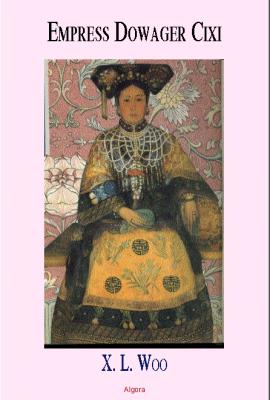
The Empress Dowager Cixi (1835 - 1908) brought destruction to the Qing Dynasty, the last feudal dynasty in the long history of China. Written with remarkable charm and verve, this book is a delightful exploration of the life of an extraordinary woman leader and her long reign, relating both historical facts and apocryphal anecdotes about her private affairs. How did she climb from the bottom rung of the ladder as an ordinary ambitious girl to the top rung of power as an empress of China? How did she grow from an inexperienced girl to a mature politician who managed to maintain her sovereign status for 48 years? How many lovers, and how many murder victims can she claim?
About the Author
X. L. Woo has published a series of narrative histories of China with Algora Publishing. Mr. Woo graduated from the prestigious Zhongshan University (Sun Yat-Sen University) in Guangzhou, China, and taught English at East China Normal University in Shanghai for more than ten years, then came to the United States on a visiting professorship at Rutgers University. A bilingual writer and poet, he has published four books in Chinese and several books in English. His essays and columns in Chinese are published in US Chinese newspapers, and one of his novels was published in a local Chinese newspaper in serial form. His translations of poems from both English into Chinese and Chinese into English have been published in magazines in China and Hong Kong.
|
|
About the Book
In all the history of China, only two women ever conquered and held the heights of power. Both enjoyed long reigns characterized by ruthless intrigue; they maintained an iron grip at the center while the vast country was torn by rebellions and...
In all the history of China, only two women ever conquered and held the heights of power. Both enjoyed long reigns characterized by ruthless intrigue; they maintained an iron grip at the center while the vast country was torn by rebellions and caught up in foreign wars. Through their policy decisions as well as their personal foibles, both left a deep imprint in history and in the minds of the Chinese people, fueling literature and legend.
Fighting to maintain her power base, Empress Cixi struggled with the need to modernize the painfully backward empire she had inherited while honoring age-old traditions. She studied previous rulers' failures and achievements, and especially followed the example of Wu-Hou, China's first female leader who had elevated herself from concubine to empress some 1200 years earlier.
The stories that follow, some of them legendary, offer a glimpse of life during the declining days of the last Chinese dynasty. Popular rebellions, foreign wars, devastating floods and drought-induced famines killed tens of millions in� 19th century China. Cixi learned her lessons well. She fended off every adversary, prolonging her reign for 48 years. But all her craft and guile were not enough to repair the internal divisions and preserve traditional China against the onslaught of modernity, of Europe, and of her Asian neighbors. In the end, however, Empress Dowager Cixi (1835-1908) presided over the destruction of the Qing Dynasty.
|
More . . .
Poison and power in Beijing By Mure DickiePublished: November 7 2008 19:17 | Last updated: November 7 2008 19:17For a long time it looked as if the murderers of ChinaÃ??'s second-to-last emperor were going to get away with it.Suspicions had always surrounded the death in agony of the reformist Guangxu Emperor in November 1908, not least because it came just a day before the passing of his aunt and jailor, the conservative Empress Dowager Cixi. But historians of ChinaÃ??'s 1644-1911 Qing...
Poison and power in Beijing By Mure DickiePublished: November 7 2008 19:17 | Last updated: November 7 2008 19:17For a long time it looked as if the murderers of ChinaÃ??'s second-to-last emperor were going to get away with it.Suspicions had always surrounded the death in agony of the reformist Guangxu Emperor in November 1908, not least because it came just a day before the passing of his aunt and jailor, the conservative Empress Dowager Cixi. But historians of ChinaÃ??'s 1644-1911 Qing dynasty had pored over his medical records and concluded the 36-year-old monarch, who had spent a decade under palace arrest, probably died of natural causes.Now, however, in a piece of detective work worthy of the stars of the hit US forensic science series, CSI, investigators probing the imperial remains have established that Guangxu was killed by arsenic poisoning.The findings were released this week by a team including Beijing police scientists and experts from the China Institute of Atomic Energy. Now the way is open for what state media say could be Ã??'further researchÃ??' into the identity of the killers, a prospect that no doubt has the prime suspects Ã??' led by Cixi herself Ã??' trembling in their tombs.News of the poisoning has reawoken discussion of what might have happened if Guangxu had survived. Some historians suggest he might have created a constitutional monarchy similar to that of neighbouring Japan and thus averted the political turmoil and civil war that cost China so dearly in the 20th century.Joseph Esherick, professor of history at the University of California at San Diego, makes a more philosophical point. Ã??'One obvious message here is the highly personal nature of power in the Chinese political system Ã??' something which applied at the end of the dynasty and continues perhaps up to the present,Ã??' he says.Certainly, Guangxu was not the last Chinese head of state to find himself in personal peril from rivals in the leadership. Liu Shaoqi, state chairman, died in jail in 1969 after being brutally treated and denied medical care by Communist party comrades loyal to Mao Zedong. Things have, however, improved since then: Zhao Ziyang, the late party chief, was merely kept under house arrest after he was deposed in 1989.Public reaction to news of GuangxuÃ??'s murder has been restrained, perhaps because modern Chinese have more pressing poisonings to worry about. Confidence in the national food chain has been shaken by a series of scandals, including the contamination of milk products this year that has killed four infants and sickened tens of thousands.Anger at the milk scandal Ã??' initially hushed up to prevent it spoiling the Beijing Olympics Ã??' has been fuelled by reports that senior officials have access to a secret food supply of organic produce free of the chemicals that contaminate much fare served up to the masses. TodayÃ??'s Chinese leaders may not have to worry about having arsenic slipped into their food, but they still feel the need to be careful about what they eat.The writer is an FT Beijing correspondentCopyright The Financial Times Limited 2008
|
|
Pages 244
Year: 2002
LC Classification: DS763.63.C58 W66
Dewey code: DS763.63.C58 W66
BISAC: BIO014000
BISAC: BIO022000
BISAC: HIS008000
Soft Cover
ISBN: 978-1-892941-88-6
Price: USD 21.95
Hard Cover
ISBN: 978-1-892941-89-3
Price: USD 28.95
Ebook
ISBN: 978-0-87586-166-1
Price: USD 28.95
|