Sound Bite
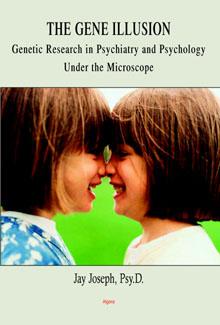
Family, twin- and adoption-studies purporting to examine the effect of genes in triggering many of today's most troubling syndromes, from Alzheimer's to autism spectrum disorders, are flawed by bias and unsupported assumptions. A clinical psychologist shows that genes may not be destiny, after all. And if genes are only secondary factors, why are so many institutions pouring so much money down the hole of genetic research, when it might be more productively invested in finding solutions ' rather than looking for genetic targets to blame?
About the Author
Jay Joseph, Psy.D., is a clinical psychologist practicing in the San Francisco Bay Area of California. Since 1998, his articles on genetic research in psychiatry and psychology have appeared in journals such as Developmental Review, The American Journal of Psychology; Genetic, Social, and General Psychology Monographs; Politics and the Life Sciences; The Journal of Mind and Behavior Psychiatric Quarterly; New Ideas in Psychology; and Ethical Human Sciences and Services. He is currently an Associate Editor of Ethical Human Sciences and Services, and an Assessing Editor of The Journal of Mind and Behavior.
|
|
About the Book
Genetic factors are increasingly presented as an important influence on psychiatric disorders, personality, intelligence, and various types of socially unacceptable behavior - as if that were an unassailable fact, proven by research.Jay Joseph's...
Genetic factors are increasingly presented as an important influence on psychiatric disorders, personality, intelligence, and various types of socially unacceptable behavior - as if that were an unassailable fact, proven by research.Jay Joseph's timely, challenging book provides a much-needed rebuttal of the evidence cited in support of genetic theories in psychiatry and psychology, which are based mainly on twin and adoption studies. He shows that, far from establishing the importance of genes, psychiatric genetic and behavior genetic research on twins and adoptees has been plagued by researcher bias, unsound methodology, and a reliance on erroneous theoretical assumptions. Furthermore, he discusses how this faulty research has been used to support the interests of those attempting to bolster conservative social and political agendas.
|
In 1925, when the eugenics movement's influence was at its height and a belief in the overriding importance of genes was widespread, psychiatrist Abraham Myerson observed, 'We often hear of hereditary talents, hereditary vices, and hereditary virtues, but whoever will critically examine the evidence will find that we have no proof of their...
In 1925, when the eugenics movement's influence was at its height and a belief in the overriding importance of genes was widespread, psychiatrist Abraham Myerson observed, 'We often hear of hereditary talents, hereditary vices, and hereditary virtues, but whoever will critically examine the evidence will find that we have no proof of their existence.'1 The evidence of Myerson's era consisted of family pedigrees, preconceived notions, and prejudice. Today it consists mainly of family studies, adoption studies, studies of twins reared together, studies of twins reared-apart, and molecular genetic research. Although it is widely believed that the results of these investigations converge on the importance of genetics, I will argue in this book that conclusions in favor of genetics based on family, twin, and adoption studies are faulty. And as we will see in Chapter 10, molecular geneticists have failed to find postulated genes for the major psychiatric disorders. Thus, Myerson's 1925 observation is more relevant to today's evidence than is commonly believed. In 1996, twin researcher Irving Gottesman wrote, 'no educated person . . . can be oblivious to the fact we are in the midst of a genetic revolution.' He added that the younger generation of genetic researchers could hardly imagine 'the uphill battle that had been fought for the past 45 years.' With what weapons was this 'battle' fought? Gottesman identified the 'old-fashioned strategies' of family, twin, and adoption studies. And he is correct that these methods helped pave the way for the ascendancy of the genetic position as articulated by the fields of behavior genetics and psychiatric genetics'¦.
|
More Information
Sound Bite Family, twin and adoption studies are flawed by bias and unsupported assumptions. A clinical psychologist shows that genes may not be destiny, after all.
Sound Bite Family, twin and adoption studies are flawed by bias and unsupported assumptions. A clinical psychologist shows that genes may not be destiny, after all.
|
Real science takes on the myths of biological psychiatry: the public and professions alike have been misled by claims for a genetic and biological basis for mental disorders. Dr. Jay Joseph's work... | More »
Real science takes on the myths of biological psychiatry: the public and professions alike have been misled by claims for a genetic and biological basis for mental disorders. Dr. Jay Joseph's work subjects these speculations to scientific scrutiny. Every dedicated mental health professional and interested lay person should read this book.
- Peter R. Breggin, MD, psychiatrist, author of Toxic Psychiatry
CHOICE
Genetic explanations for individual differences in personality, intelligence, psychopathology, and even spirituality are now more readily accepted both inside and outside the academy than at any time in the past three decades. Opposing this tendency, Joseph (a clinical psychologist and widely published scholar) argues that the emphasis on the putative contribution of genetic factors to psychological trait variation is unsound and based more on the personal convictions of the researchers than on hard evidence. He begins with an excellent systematic and comprehensive review of the history of twin research, illuminating the ties between early twin studies and the eugenics movement. He then offers a critical assessment of assumptions that underlie the inferences drawn from twin- and adoption-study data. Two chapters detail the problems with twin and adoption research on the genetic contribution to schizophrenia. Additional chapters deal with molecular genetics, the investigation of the genetic contribution to intelligence, and the misuse of the heritability statistic.
Summing Up: Highly recommended. Upper-division undergraduates through faculty interested in the history of behavioral genetics.
|
|
Pages 420
Year: 2004
LC Classification: RC455.4.G4J67
Dewey code: 616.89'042'dc22
BISAC: PSY018000
Soft Cover
ISBN: 978-0-87586-343-6
Price: USD 26.95
Hard Cover
ISBN: 978-0-87586-344-3
Price: USD 34.95
Ebook
ISBN: 978-0-87586-345-0
Price: USD 34.95
|