About the author

Stjepan G. Mestrovic

Prof. Mestrovic has testified as an expert witness at The Hague and at Fort Hood. He is the author of 17 books (two with Algora) and numerous articles. His particular areas of interest include Abu Ghraib, culture, and race and ethnic studies in the Balkans. He holds three degrees from Harvard University and has been teaching at Texas A&M since 1991.

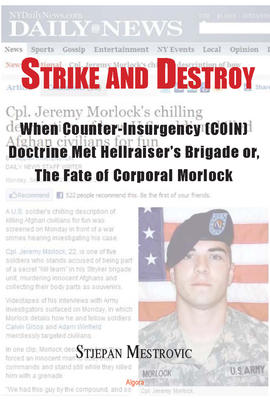
Strike and Destroy

Price range: $22.95 through $32.95

How could the ‘Maywand District killings’? (or the ‘kill team’? war crimes) have happened? Jeremy Morlock was convicted of premeditated murder, but numerous other ‘questionable kills’?

Read More

Sound Bite

In a "spontaneous-combustion theory" of war crimes, Jeremy Morlock and 4 other soldiers were charged with having murdered 3 Afghans, as if they just spontaneously did monstrous things. But in an extraordinary court-martial related to the Maywand District killings in Afghanistan in 2010, the Defense showed that in fact the atrocities originated in a failure of leadership and a dysfunctional brigade climate. Dr. Stjepan Mestrovic, a professional sociologist who has testified in the trial, explains.

About the Book

How could the 'Maywand District killings' (or the 'kill team' war crimes) have happened? Jeremy Morlock was convicted of premeditated murder, but numerous other 'questionable kills' in his brigade, committed by other soldiers in other units in 2010, were never investigated.The brigade commander went by the name Hellraiser, and an internal army investigation revealed that the officers of the brigade were hopelessly confused as to their mission. No one knew if they should obey the chain of command and "do COIN," in other words, "sit down for tea with the village elders', or carry out Hellraiser's and the army's traditional counter-guerrilla doctrine. Hellraiser's refusal to carry out COIN doctrine led to complete social dysfunction in the brigade. Normal army standards of discipline, drug testing, group cohesion, mentoring, counseling, among other standards, were abandoned.Prof. Mestrovic connects the social dysfunction in Hellraiser's brigade with Morlock's crime. He shows that COIN doctrine was treated as a joke in the brigade while a 'Strike and Destroy' mentality was dominant.This inside account relies upon an internal army investigation into the command climate of Hellraiser's brigade, conducted by Brigadier General Stephen Twitty, along with court-martial transcripts, and direct interviews. This book analyzes one war crime incident as an example of the general failure, or refusal, to implement COIN doctrine in Afghanistan.

About the Book

In 2010, a group of U.S. soldiers in Afghanistan was charged with murdering Afghan civilians in what became known as the Maywand District killings — or simply the "kill team" case. Corporal Jeremy Morlock was convicted of premeditated murder, but sociologist Stjepan Mestrovic argues that treating these atrocities as the spontaneous acts of a few bad soldiers misses the real story entirely.

Mestrovic, who served as an expert witness in the court-martial proceedings, makes a compelling case that the killings grew directly out of a catastrophic failure of military leadership. At the center of the crisis was Colonel Harry Tunnell, known to his men as "Hellraiser," whose 5th Stryker Brigade operated in open defiance of official U.S. Army counterinsurgency doctrine — the approach known as COIN, which emphasized winning over civilian populations rather than pure combat operations. Tunnell reportedly told his soldiers "kill first, then capture" and openly dismissed the hearts-and-minds strategy as irrelevant.

Drawing on sworn statements from generals, chaplains, battalion commanders, and junior officers, Mestrovic reconstructs how Tunnell's brigade descended into social dysfunction — with drug use going untested, discipline collapsing, and soldiers trained to see every Afghan as a potential enemy. The book examines how conflicting orders from the chain of command on one side and Hellraiser on the other left troops without moral or tactical direction.

This is a serious, carefully documented look at how institutional failure, not individual evil, creates the conditions for war crimes. Readers interested in military justice, Afghanistan, and the human cost of failed leadership will find it essential reading.

Additional information

Weight N/A
Book Type Ebook, ePub, Hard cover, Soft cover
Pages

248

Release Year

BISAC I

LAW068000

BISAC II

HIS027190

Reviews

There are no reviews yet.

Be the first to review “Strike and Destroy”

Your email address will not be published. Required fields are marked *

Related books