About the author

Donald A. Wells

Donald A. Wells is emeritus professor of philosophy from the University of Hawaii at Hilo; his earlier professorships were at Oregon State University, Washington State University, and the University of Illinois.He has taught courses and written articles on the United Nations for the past twelve years. He is vice chair of the UNA of USA of Southern Oregon. Earlier published books include God Man and the Thinker: Philosophies of Religion (New York: Random House, 1962), The War Myth (New York: Pegasus, 1967), War Crimes and Laws of War (Lanham: University Press of America, 1984), War Crimes and Laws of War revised 1991, The Laws of Land Warfare (Westport: Greenwood Press, 1992), and An Encyclopedia of War and Ethics (Westport: Greenwood Press, 1996).

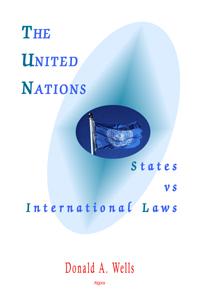
The United Nations: States vs. International Laws

Price range: $22.95 through $28.95

Few Americans understand why the United Nations can’t do more when facing catastrophes like those in the former Yugoslavia, East Timor, and Palestine/Israel. The author traces the UN’s

Read More

Sound Bite

At a time when there are so many questions over national sovereignty versus the international community's right and responsibility to intervene in crisis situations, America cannot and ought not to act alone. Here, examining the premier organization of the international community, Dr. Wells explores the great accomplishments and great failures of the UN, and shows how its structure creates operational strengths and weaknesses. He explores the US use of the veto, the legitimacy of US special military courts, and the bases of internationally accepted law.

About the Book

Few Americans understand why the United Nations can't do more when facing catastrophes like those in the former Yugoslavia, East Timor, and Palestine/Israel. The author traces the UN's weaknesses to the compromises that were made at its founding, and highlights all the organization has accomplished despite these handicaps.The book shows that the United Nations structure was tailored to suit the United States, in 1944, to ensure that decisions in the General Assembly (where we might be outvoted) would be considered "recommendations" which could be ignored.The US use of the veto is explored, especially as it has made it impossible for the U.N. to serve as the appropriate reconciler to resolve the Palestine-Israel conflict.Why did the US delegate vote against the Convention Against the Discrimination of Women, the Convention on the Rights of the Child, and the Kyoto Protocol on Global Warming? These and similar questions are addressed.The book explains the role of the U.N. Security Council in establishing when a "threat to the peace" exists, whether an embargo is legitimate, and whether, in the last instance, military action is justified.The author considers both the importance of the newly ratified International Criminal Court (ICC), and the reasons for the US rejection of such a Court. In view of the current debates over the authenticity of the 1949 Geneva Conventions as they speak to the treatment of "prisoners of war," the role of U.N. declarations is especially critical. Can the leader of any state arbitrarily invent international laws, while rejecting conventions ratified by a majority of the world's nations?

About the Book

Most Americans have a vague sense that the United Nations is either ineffective or irrelevant, but few understand why. Donald A. Wells argues that the UN's limitations were built in from the start — and largely by the United States itself. At the 1944 Dumbarton Oaks conference, American planners designed the UN to ensure it could never seriously challenge national sovereignty, particularly American sovereignty. The Senate had rejected the League of Nations in 1919, and to avoid repeating that failure, US leaders made sure the new organization would have no standing army, no real financial power, and a Security Council where five permanent members — the US, Soviet Union, France, the UK, and China — could each veto any action they disliked.

Wells walks through how these structural choices play out in practice. General Assembly resolutions were deliberately classified as "mere recommendations," meaning countries could ignore them without penalty. The US has used its veto repeatedly to block UN involvement in the Palestine-Israel conflict. American delegates voted against the Convention on the Rights of the Child, the Convention Against Discrimination of Women, and the Kyoto Protocol on Global Warming — decisions that often baffled international observers but make more sense once the underlying politics are understood.

The book also covers war crimes law, from the post-Civil War trial of Captain Henry Wirz to the founding of the International Criminal Court, and examines how trade bodies like NAFTA and the WTO have sidestepped the UN's human rights and labor frameworks. For anyone trying to understand global governance, UN reform, or why international law so often seems toothless, this is a clear and well-argued starting point.

Additional information

Weight N/A
Book Type Ebook, Hard cover, Soft cover
Pages

204

Release Year

LC Classification

JZ4984.5.W46

Dewey code

341.23'dc22

BISAC I

LAW051000

BISAC II

POL001000

BISAC III

POL021000

Reviews

There are no reviews yet.

Be the first to review “The United Nations: States vs. International Laws”

Your email address will not be published. Required fields are marked *