


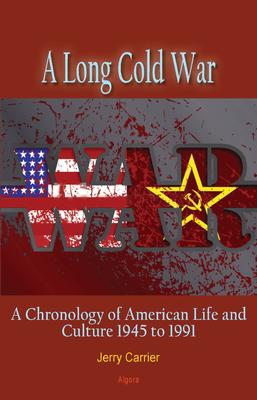
Sound Bite
A Long Cold War is a cultural history of the United States during the Cold War from 1945 to 1991. This is the story of America at her peak as a world power, when the fear of nuclear war and hyper competition with the USSR and China went hand in hand with a passion for consumer goods and light entertainment.
Written in an almanac or journal form, it is a reference to give the reader a complete sense of what it would have been like to live in these times as events unfolded. The entries include scientific, political, cultural, military, sports, and weather events, inventions, and major calamities, as well as the fads of the day.
About the Book
What was it really like to live through the Cold War in America? This year-by-year chronology brings it back.
Jerry Carrier covers every year from 1945 to 1991, mixing the headlines with the everyday details that made up American life. Readers learn what people earned and what things cost, what they watched, read and listened to, and what fears kept them awake at night.
The landmarks are all here: the Korean War, McCarthyism and the Red Scare, the Cuban Missile Crisis, the Kennedy assassination, Vietnam, the civil rights movement, the moon landing and Watergate. Most events are told in a sentence or two, the way you might have read the headline at the time. Major turning points get fuller treatment to show their complexity and impact.
The result is part almanac, part social history: a vivid record of how much America changed over nearly five decades of nuclear standoff.
A great reference and a pleasure to browse, for students, writers, history buffs and anyone who remembers these years.
Introduction
At the end of WWII the nation state version of the last man standing was the United States of America. The industrial capacity of Europe and Asia were completely destroyed by the war and the only nation of significant power that had any major industrial capacity was the United States. Even the civilian populations of the combatants in Europe, Asia and the Pacific were devastated while the American civilian population was left relatively unscathed. The US homeland, with the exception of Pearl Harbor and a few insignificant attacks, was largely untouched by the war. The US was the only major industrial power that was not destroyed.In the summer of 1945 this manufacturing capacity, coupled with America's dominate military might and the discovery and use of the atomic bomb made the US the unquestioned world power. The only armies strong enough to compete with the US were that of the USSR and to a lesser extent China in a very limited regional capacity in Korea. This post war rise to power also saw the US become the new leader of the English speaking world as the United Kingdom's power declined and Britain became an appendage to American power. This was a bitter pill for the British to swallow as they watched the sun setting on the once vast British Empire where they had once fondly boasted that the sun never set. They were now forced to recognize that they owed their WWII victory to American and Soviet power and that they were now secondary players in a new Cold War.The Western European powers and Japan pledged their allegiance to the US as they saw and feared the Soviet Union's domination of Eastern Europe and Communist China's rising dominance in East Asia. After the war, the Europeans appeared powerless stop the demise of their colonies in Asia, Africa, and Latin America as independence movements arose. The colonial powers quickly sought to preserve some of their colonies with American assistance. America's rivalry and subsequent Cold War competition with the Soviets and China was used by the Western Europeans to persuade America to assist them in retaining their colonial powers as this nationalist freedom movement was frequently labeled (or mislabeled) "communist." America then became a primary hindrance to these movements. The colony of French Indo-China (Vietnam) was the most calamitous engagement for the US, as the US replaced the French as the colonial power, but there were many other American interventions with disastrous results. America's foreign policy in the last half of the 20th century was consumed by these movements and their fear they would tilt toward communism or socialism. President Eisenhower and the two brothers, John Foster Dulles his Secretary of State and Allan Dulles the head of the CIA were the primary proponents of this anti-nationalist contingency in the US. They called it the domino theory. If one fell, the others would follow.They saw the USSR and China as competition to dominate and spread their influence over the former colonies. Eisenhower and the Dulles brothers labeled most freedom movements as communistic or socialistic and they fought their cold war over this "Third World."In 1949 when China became communist and the USSR created the atomic bomb, the US feared that communism would overrun the globe with nations falling to Sino-Soviet communism again like a of a row of toppling dominoes. Communism was expanding in the post colonial world, but it was more a reaction against their colonial masters than the success of a Sino-Soviet master plot as the Americans and Western Europeans claimed. China, Vietnam and even Korea were never Soviet puppet states, as the US maintained. Communism never really threatened the US and these fears of a communist takeover of the US were mostly paranoia and/or propaganda. Americans became xenophobic, they feared the other. In 1945 Americans were just entering this Cold War, a long and sometimes violent war that would last for about forty-seven years.In the wake of WWII and the Great Depression, America was also hungry for consumer goods. Now that the industrial powerhouses of Europe had been destroyed, Americans with their unchallenged industrial capacity were about to experience their best economic times. They would see the creation of new consumer products that would revolutionize the world. This is the story of America in those times, the prosperity, the paranoia and the power. It was America's time.A Note about the Cold WarMost look at 1945, the end of WWII, as the beginning of the Cold War. However, some disagree. Europe and America's distrust of communists dates back to at least the late 19th century ; and then WWI and the Russian civil war that began as the war with Germany was nearing an and. The October Revolution ignited in 1917. The main invasion took place in Vladivostok and was called the Siberian Expedition. The allies occupied the port and surrounding areas; the last of them withdrew in 1922, finally concluding that Czarist Russia would not return. The Americans, British, French and Canadians also invaded Northern Russia in the Archangel Campaign and occupied parts of Northern Russia until 1920. Some historians mark these invasions as the real beginning of the Cold War between the Soviets and the West.In October 18, 2008, Nick Holdsworth (reporting for the British newspaper The Telegraph) reported that secret documents showed that Stalin made an offer to the British, Poles and French in August of 1939, just before war broke out with Germany, to put a million Soviet troops in Poland on the German border to smother Hitler's ambitions. It was ignored by the Allies. The primary reason given for the British, French and Poles rejecting Stalin's offer was that some felt that Stalin was as ambitious as Hitler and would occupy Eastern Europe, including Poland, and that the million Soviet troops would never leave. Two weeks later Stalin signed his notorious treaty dividing Poland with Germany, and Hitler invaded Poland, starting WWII. Some see this reluctance to ally with the Soviet Union against Germany in 1939 as the start of the Cold War.



Reviews
There are no reviews yet.