About the author

X. L. Woo

X. L. Woo has published a series of narrative histories of China with Algora Publishing. Mr. Woo graduated from the prestigious Zhongshan University (Sun Yat-Sen University) in Guangzhou, China, and taught English at East China Normal University in Shanghai for more than ten years, then came to the United States on a visiting professorship at Rutgers University. A bilingual writer and poet, he has published four books in Chinese and several books in English. His essays and columns in Chinese are published in US Chinese newspapers, and one of his novels was published in a local Chinese newspaper in serial form. His translations of poems from both English into Chinese and Chinese into English have been published in magazines in China and Hong Kong.

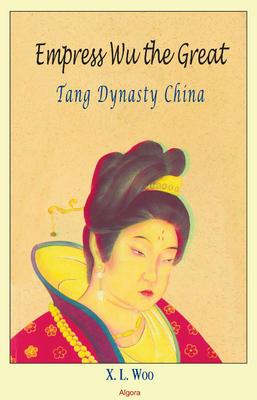
Empress Wu the Great

Tang Dynasty China

Price range: $21.95 through $29.95

Empress Wu was stunning in her beauty, in her ruthless elimination of rivals (including sons and daughters), and, most important, in her discernment.

Read More

Sound Bite

Europe and Great Britain have had sovereign queens; but in ancient China, there was none of that. Only one Empress ever ruled China in her own name — Empress Wu. Given her startling performance in a world of deadly intrigue and shifting loyalties, Wu is still respected as an effective and clear-sighted ruler.

About the Book

Empress Wu was stunning in her beauty, in her ruthless elimination of rivals (including sons and daughters), and, most important, in her discernment. Wu Zetian was esteemed for appointing capable officials throughout the realm, and she implemented reforms that improved standards of higher education, gave some status to women, and 'democratized' the recruitment of candidates for official posts by eliminating the requirement that they be nominated by someone within the establishment.

Related in an easy-reading style, the facts in the book are derived from China's classic historical record the Zizhitongjian (meaning 'History is a mirror to help rule'), which was written by a courtier in Song Dynasty, the very next dynasty after the Tang Dynasty. Beginning in AD 617, the narrative traces the rise of Wu's father from humble bean-curd dealer to army officer and friend of the Emperor; her own arrival at age 13 as a concubine to the Emperor; and the brilliant exploitation of opportunities by which she attained the throne.

Other empresses had ruled China for a time while their husbands were weak and their sons were young; Wu did the same from 665 to 690. But Wu achieved a higher status than any woman before or since when she declared her own dynasty in 690 and ruled directly for another 15 years. Readers are treated to some of the flavor of life inside the capital, then at Xi'an, the eastern tip of the great Silk Road (now known in international tourism as the site of the famous Terracotta Warriors).

In those years the Chinese ruler held sway far to the south, into Indochina, and westward as far as today's Kyrgyzstan. Brief descriptions indicate the tumultuous events unfolding throughout Asia as China vied with Mongol tribes and the Tibetan Empire to establish the map we know today — and some of the disputes over boundaries and sovereignty that are still ongoing.
About the Book

In all of Chinese history, only one woman ever ruled the empire in her own name. That woman was Wu Zetian, later known as Empress Wu the Great, and her story is one of the most remarkable political rises ever recorded. Born in 624 AD during the Tang Dynasty, Wu entered the imperial court at just 13 years old as a concubine to Emperor Taizong. What followed over the next several decades was a masterclass in survival, strategy, and power.

Author X. L. Woo draws on the Zizhitongjian, China's authoritative classical historical record compiled during the Song Dynasty, to trace Wu's journey from the imperial harem to the throne itself. The book doesn't flinch from the darker chapters — Wu's ruthless elimination of rivals, including members of her own family, and the bloody suppression of rebellions mounted by the princes Li. But it also gives serious credit to her achievements as a ruler: she reformed the civil service examination system to open government posts to talented candidates outside the established elite, raised educational standards, and elevated the status of women in a society that had long treated them as little more than property.

Woo covers Wu's foreign policy dealings with Tibet, Korea, Japan, and Arabia, and explores the legends that grew up around her, including tales of face reading and flowers blooming in winter. This is accessible, narrative-driven history that makes Tang Dynasty China feel vivid and immediate — a fascinating portrait of a woman who refused the role history had assigned her.

Additional information

Weight N/A
Book Type Ebook, ePub, Hard cover, Soft cover
Pages

188

Release Year

LC Classification

DS749.42.W8W66 2008

Dewey code

951'.017092'dc22

BISAC I

HIS008000 HISTORY / Asia / China

BISAC II

BIO014000 BIOGRAPHY & AUTOBIOGRAPHY / Royalty

BISAC III

BIO022000 BIOGRAPHY & AUTOBIOGRAPHY / Women

Reviews

There are no reviews yet.

Be the first to review “Empress Wu the Great”

Your email address will not be published. Required fields are marked *

Related books