About the author

Daniel Spikes

Dan Spikes is an independent writer whose work grows out of a lifetime spent among the world’s cultures and faiths. After graduating from Stanford University, he lived and worked for several years in Côte d’Ivoire and Burkina Faso, traveled through Morocco, Senegal, Mali, Liberia, Ghana and Niger, and crossed the Sahara overland through Niger, Algeria and Tunisia. He later traveled in Lebanon, Syria, Jordan and the Muslim regions of India.

Dan is the author of Angola and the Politics of Intervention: From Local Bush War to Chronic Crisis in Southern Africa. He has lectured on the origins of Islamic extremism at the Université Inter-Âges in Versailles, and lives in Provence, France.

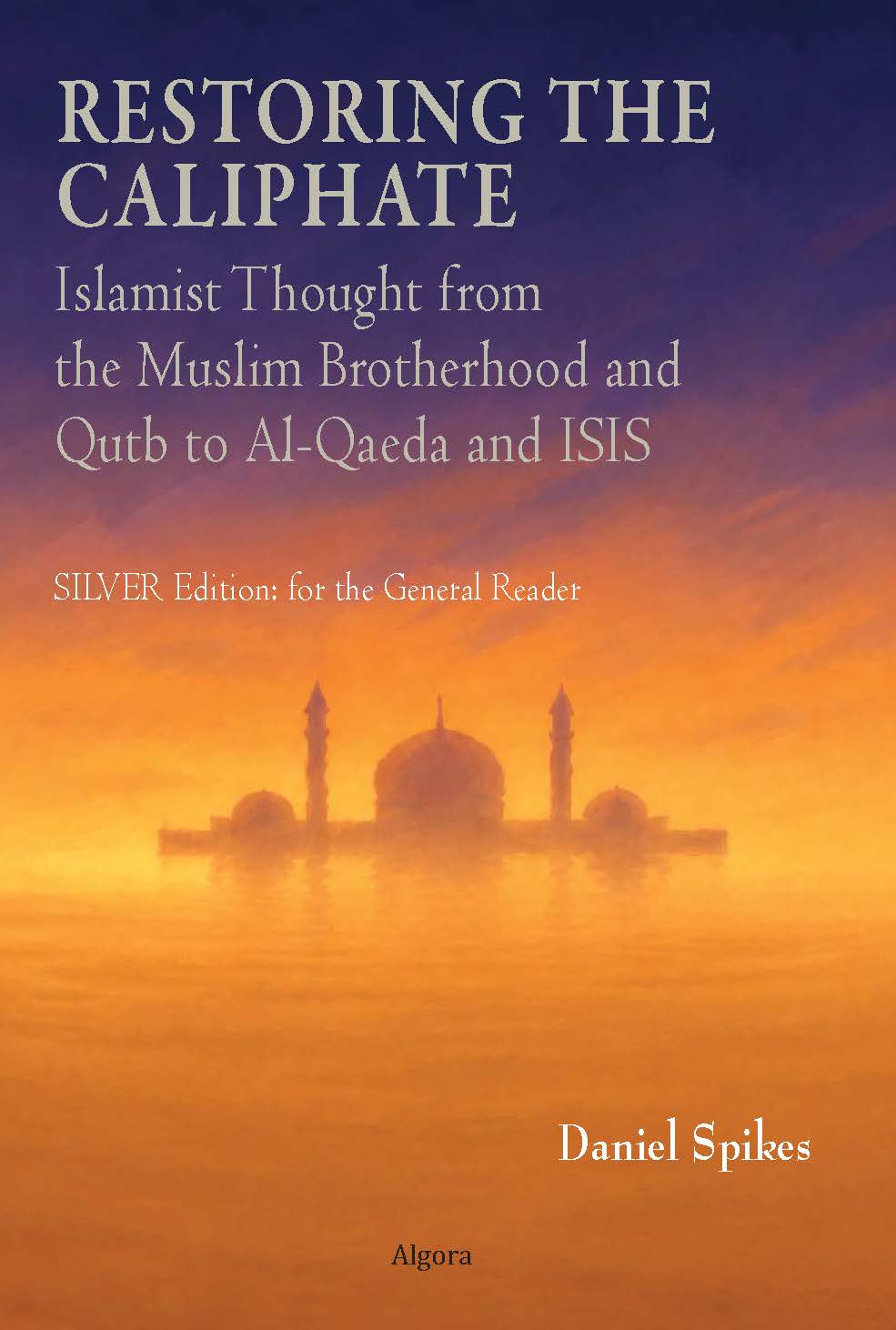
Restoring the Caliphate

Islamist Thought from the Muslim Brotherhood and Qutb to Al-Qaeda and ISIS — "Gold" Expanded Edition

This is the story of Islamism’s journey from the idealism of the early Islamists to the regrettable violence of some of the movement’s later protagonists, an historical trajectory that cannot be understood unless the movement is situated within the context of broad 20th and 21st century geo-politics.

Read More

Coming Soon

Sound Bite

Restoring the Caliphate is a profound exploration of the mechanics, spirituality and, ultimately, the folly of mankind’s futile search for perfection. The work is published in two versions: An Expanded Gold Edition for libraries and specialists and a Silver Edition for general readers.

Both editions tell the same story; "Gold" adds depth, not new territory. Its extra ~50,000 words go mainly to close readings of the movement's key texts, the Cold War diplomacy around them, and fuller portraits of the thinkers.

About the Book

Author Dan Spikes traces the historical and ideological evolution of "Political Islam" (Islamism) and the modern quest to establish an "Islamic state" — the intellectual, political, and social roots of Islamism from the early caliphate through European imperialism, Arab nationalism, the Muslim Brotherhood, Iran’s revolution, key events from Ottoman fall to 9/11, Afghanistan, al‑Qaeda and ISIS, critiquing both Western policies and jihadist ideologies.

Introduction

From the Prophet's Medina to the ISIS caliphate: the 150-year quest to build an Islamic state, and why it keeps failing.

For many Muslims, the community the Prophet led in seventh-century Medina was the first Islamic state, and the model for any that would follow. Searching for the Islamic State traces the modern effort to rebuild it, and the reformers, ideologues and revolutionaries who led it.

Dan Spikes shows how colonial rule, failed nationalism, state repression and Cold War rivalry shaped each stage. He takes the Islamist thinkers seriously on their own terms without excusing their violence, and writes with wit and a sharp eye for contradiction.

The "Silver" General Edition 

The General Edition tells the complete story in a streamlined text for the general reader, with full notes. Readers who want the close readings of the movement's key texts and a fuller account of the Cold War diplomacy behind it will find them in the Expanded Edition.

The "Gold" Expanded Edition

The Expanded Edition is the author's complete text, nearly half again as long as the General Edition. It adds:

  • A chapter-by-chapter reading of Sayyid Qutb's Milestones
  • Maududi's blueprint for an Islamic legislature and head of state, and Pakistan's Objectives Resolution
  • Khomeini's Islamic Government and the workings of Iran's Guardian Council
  • The Syrian Brotherhood's program for an Islamic state, and Hassan al-Turabi's theory of it
  • Azzam's fatwa on jihad, Zawahiri's attack on the Brotherhood, and Zarqawi's letter to al-Qaeda
  • Great Power diplomacy: Dulles, Mossadegh and Bandung; the Soviet decision to invade Afghanistan; Brzezinski and Casey

An epilogue asks what this history can teach the West about its own religious nationalism.


About the Book

Islamism’s journey from the idealism of the early Islamists to the regrettable violence of some of the movement’s later protagonists cannot be understood unless the movement is situated in its broader geo-political context. The narrative toggles between Islamist introspection and the actions of select actors and between regional dynamics and the great geo-political controversies of the 20th and 21st centuries.

Confusion over “what to do” about Islam bedeviled American foreign policy makers throughout the 20th and into the 21st century. Early presumptions that “Islam implies autocracy” or that the world’s “Mohammedans” were forgettable relics of a medieval religion ill adapted to the modern world progressively gave way to greater pragmatism, notably following President Roosevelt’s entente with the oil-rich Wahhabi monarch of Saudi Arabia on the Great Bitter Lake in 1945. Three years later, President Truman’s pivotal role in helping midwife the state of Israel exposed the US, in Islamist eyes, as a modern Crusader state and unapologetic enemy of the Islamist ideal.

Cold War era attitudes towards Islam in the US ran the gamut from fears Muslims were easy marks for the world’s communist regimes to the stubborn hypothesis that the God fearing followers of the Prophet must, in the end, be the natural friends and allies of the “Christian” West. The later theory led to the hasty conclusion that Islamist extremists could be partners in the good fight against global communism, a stratagem that came undone in the later part of the 20th century when to America’s horror Islamism replaced communism in many US policy makers eyes as the main enemy of the West.

Often portrayed as strange and other worldly, the book reveals the Islamist viewpoint to be as integral to the modern world as the American experiment itself, a theme brought home when the Islamists’ fears and impulses are shown to mirror the distress and anguish of the rioters who stormed the US Capitol on January 6, 2021.

Additional information

Book Type ePub, Hard cover, Soft cover
Release Year

Reviews

There are no reviews yet.

Be the first to review “Restoring the Caliphate”

Your email address will not be published. Required fields are marked *