About the author

Alexander V. Avakov

Alexander V. Avakov was born in the USSR. Interested in economic statistics since childhood, he accomplished his formal university education in mathematics and mathematical economics with additional studies in economics, philosophy, law, politics, anthropology, sociology and psychology. As a result of early political maturity he was arrested in 1975 for distributing liberal-minded leaflets at the university. Sentenced to a year and half of hard labor, he was sent to a KGB-run camp for political prisoners. After completing the prison term, he emigrated from the Soviet Union and has since settled with his family in the United States. Mr. Avakov has published several books with Algora, including Plato’s Dream Realized: Surveillance and Citizen Rights, from KGB to FBI, and a variety of statistical studies analyzing the relative power of nations in terms both economic and military, including undeclared nuclear weapons. Previously published books in Russian include, among others, Autobiography of the Soviet Anti-Soviet Philosopher, and Welcome to the New Security State. 

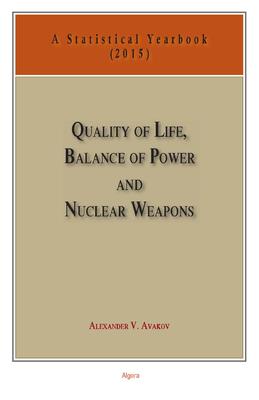
Quality of Life, Balance of Power, and Nuclear Weapons (2015)

A Statistical Yearbook for Statesmen and Citizens

Price range: $22.95 through $32.95

This statistical annual presents fundamental data comparing measures of (1) Quality of Life, (2) Balance of Power, and (3) Developed Market Economies since 1960. It is far more complete other statistical publications.

Read More

Sound Bite

Who has the most nuclear assets in the Middle East? Whose power is waning, whose increasing? Updated annually, these tables of economic, demographic and military indicators establish the pecking order for 236 countries, with estimates of all nuclear arsenals including rarely published data on non-signatory nations.The author also brings a rational perspective to the public debates on the supposed efficiency of private health insurance versus a “public option,” and the notion that taxation stifles the economy, by offering comparative statistics from different countries in the developed world.

About the Book

This statistical annual presents fundamental data comparing measures of (1) Quality of Life, (2) Balance of Power, and (3) Developed Market Economies since 1960. It is far more complete other statistical publications. Section 2 includes data about nuclear delivery systems and the number of nuclear warheads of all nuclear powers, including estimates of the Israeli nuclear arsenal which usually do not appear in the press.Many official estimates distributed by U.S. and British intelligence communities, for example estimates of Russian and Chinese military expenditures, are methodologically flawed, claiming to compare military expenditures at market exchange rates while apparently citing Russian and Chinese figures at purchasing power parities, thus inflating these numbers in comparison to those of other countries. This book corrects the distortion by presenting two different tables, showing military expenditures estimates both at market exchange rates and by purchasing power parities.Members of the U.S. Congress and others who care about the foundations of power politics in the nuclear age will find facts that speak for themselves in this novel yearbook.

About the Book

Now in its eighth annual edition, this data-rich reference book by Alexander V. Avakov tracks how countries around the world stack up on quality of life, military power, and nuclear weapons capacity. Using 2013 figures sourced from the World Bank, the CIA, and other major databases, it covers 236 countries and territories — including five disputed states like Abkhazia, Nagorno-Karabakh, and Transnistria that rarely appear in mainstream statistical publications.

One of the book's most pointed arguments is that U.S. and British intelligence agencies, including the CIA and IISS, have been systematically overstating Russian and Chinese military expenditures by mixing up market exchange rates with purchasing power parities. Avakov corrects this by presenting both calculations side by side, giving readers a more honest picture of the actual global balance of power.

The quality of life section goes well beyond GDP, pulling together data on infant mortality, life expectancy, press freedom, income inequality, and human rights — including a revived human rights index based on Charles Humana's methodology, last calculated in 1991. The nuclear weapons section is especially notable for including estimates of the Israeli arsenal, operational delivery systems for all nuclear powers, and rarely published figures on non-signatory nations. For anyone trying to understand how military strength, economic wellbeing, and political freedom relate to each other across the globe, this yearbook offers a uniquely comprehensive and independent-minded set of tools.

Additional information

Weight N/A
Book Type Ebook, ePub, Hard cover, Soft cover
Pages

242

Release Year

BISAC I

REFERENCE / Yearbooks & Annuals

BISAC II

POLITICAL SCIENCE / Reference

BISAC III

POLITICAL SCIENCE / International Relations / Arms Control

Reviews

There are no reviews yet.

Be the first to review “Quality of Life, Balance of Power, and Nuclear Weapons (2015)”

Your email address will not be published. Required fields are marked *

Related books