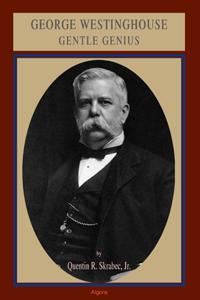
About the author

Quentin R. Skrabec Jr.

Working from a home base in the industrial heartland of northern Ohio and Western Pennsylvania, for twenty years Quentin R. Skrabec Jr. has been researching the history of America’s industrialization and the key figures who moved the process forward, resulting in a series of biographies of American industrialists published by Algora. He has published over fifty articles on history, industrial history and business, and five books on the late 1800s and American business. Prof. Skrabec has been an Associate Professor of Business at the University of Findlay, OH, since 1998. He has taught as an adjunct professor at the University of Toledo, the University of Akron, University of Pittsburgh, and Robert Morris University.A Pittsburgher himself, from this section of the city, Quentin Skrabec grew up in its rich heritage. Having written biographies of some of its most successful residents — Heinz, Westinghouse, McGuffey, Carnegie, and Frick, in this book Prof. Skrabec develops many stories of the famous capitalists who lived in Pittsburgh’s East End. 

The Fall of an American Rome

Deindustrialization of the American Dream

Price range: $22.95 through $32.95

The author considers US industrial policies that have shaped today’s economic landscape and finds that, however well-intended, our polices have been misguided. Free trade was to promote world peace and democracy.

Read More

Sound Bite

This is the story of the de-industrialization of America, written by a Business professor with a background in steel company management who grew up in the city of Pittsburgh and loved its manufacturing environment.

The book is based on the facts and aims to avoid any partisan political viewpoint - which is not as difficult as it may seem, since both U.S. political parties support free trade economics. The story does not single out the union, the workers, management, politicians, or American voters and consumers, since there is plenty of blame to share. Even the economic policy of the country since 1945, which clearly must carry a large portion of the blame, was accepted for all the right reasons.

About the Book

The author considers US industrial policies that have shaped today's economic landscape and finds that, however well-intended, our polices have been misguided. Free trade was to promote world peace and democracy. No one foresaw the ancillary effects of the 1970s on the United States. Yet this approach has brought destruction upon our cities, workers, managers, and country.Dr. Skrabec writes - not to condemn or demonize any party to this debacle - but out of a love for American manufacturing and those once-robust cities such as Detroit, Toledo, Pittsburgh, Akron, and so many others, that drove the American economy to the top.

Introduction

In the 1980s I would experience firsthand one of the nation's largest steel mergers, and a few years later one of its largest bankruptcies. As the manufacturing base collapsed in America, I left industry to obtain a PhD in manufacturing. Initially, I hoped to help drive a manufacturing revolution with such programs as Lean Manufacturing, Six Sigma, and ISO 9000. This type of program, while extremely helpful to industry, was unable to overcome the political and economic infrastructure in America today. We have a policy of de-industrialization, although no one refers to it that way. Instead we are told of a post-industrial strategy where information will be the source of jobs. Still, I believed manufacturing could be saved...

About the Book

Quentin Skrabec Jr. grew up in Pittsburgh and worked in the steel industry, and that personal connection gives this book a weight that purely academic treatments of deindustrialization often lack. His argument is straightforward but troubling: the hollowing out of American manufacturing was not the work of villains or conspiracies, but the slow, compounding result of well-intentioned policies that nobody fully thought through. Free trade, embraced after World War II by both political parties, was meant to build world peace and spread democracy. What it also did, by the 1970s, was gut cities like Youngstown, Akron, Detroit, and Pittsburgh.

Skrabec traces the story from its ideological roots in the Mont Pèlerin Society, which shaped the free-market thinking that dominated postwar economic policy, all the way through the factory closures and community collapses of the 1970s and 1980s. He looks at specific places and moments that defined the crisis — the Lordstown and Conneaut plants, the collapse of the Mahoning Valley, the fall of Jones and Laughlin Steel, and the slow death of Saturn. The year 1982 gets its own chapter, and rightly so, given how many industrial communities were devastated in that single year.

What makes this book stand out is its refusal to assign blame neatly to unions, corporations, or any single political party. Both Democrats and Republicans, Skrabec argues, have preferred to exploit deindustrialization for votes rather than solve it. He closes with a provocative question: should America revisit something like the old Whig Party's protectionist American System? For anyone trying to understand how the Rust Belt got that way, this is essential reading.

Additional information

Weight N/A
Book Type Ebook, ePub, Hard cover, Soft cover
Pages

216

Release Year

BISAC I

BUS070050

BISAC II

BUS000000

Reviews

There are no reviews yet.

Be the first to review “The Fall of an American Rome”

Your email address will not be published. Required fields are marked *

Related books