About the author

Lawrence R. Lenz

Lawrence Lenz has taught US, European and World History at the college, adult school and high school levels. He earned his master’s degree in history and foreign policy at Norwich University and an undergraduate degree in history at the Virginia Military Institute; in addition he holds an MBA.

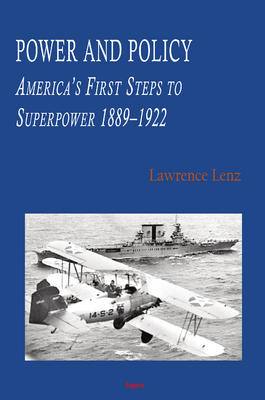
Power and Policy: America’s First Steps to Superpower 1889-1922

Price range: $22.95 through $32.95

Through its military policy and foreign policy, America attained superpower status in a remarkably short period of time. Nations survive based on their ability to provide internal order and external defense.

Read More

Sound Bite

This book shows how the United States made itself into a superpower. Highlighting major foreign policy and military successes in the late 19th century and early 20th century, the author explains how these "wins" were supported by technological achievements and demographic and economic growth. Written for American history students, military history buffs, and the general reader, the book discusses  everything from naval battles to political battles that shaped the American nation.

About the Book

Through its military policy and foreign policy, America attained superpower status in a remarkably short period of time. Nations survive based on their ability to provide internal order and external defense. Unfortunately, foreign policy goals are not always attained, and sometimes those goals are based on questionable concepts. Power and Policy examines the relationship of the US military and naval power with its foreign policy objectives, exploring the policies and the use of force that propelled the United States into the first ranks of world power. The book asks when military action is needed and how such action can change the very context within which foreign policy unfolds. The study focuses on twelve major decisive events in history during the late 19th and early 20th centuries, including: Ã??'¢    a hurricane in Samoa and its effect on the German and US navies,Ã??'¢    the outcomes that followed the Spanish-American War, Ã??'¢    the role of Panama in the development of a trans-continental powerhouse,Ã??'¢    the US approach to southern neighbors including Nicaragua and Mexico, Ã??'¢    maneuvering for a stronger global position at the conclusion of World War I,Ã??'¢    and the establishment of naval parity with Great Britain. The facts, background and analysis enable readers to understand interventions that defined and then re-defined United States foreign policy for the rest of the 20th century.Documented with illustrations of policy debates and with tables listing the evolution in US naval strength as the country spanned the continent, both the requirement and the means are explained for the shift from a stance of coastal defense to world power. A great gift for men and women interested in US history, military history, and naval history, Power and Policy examines the origins of US involvement with guerilla war and terrorism; the evolution of the Military-Industrial Complex; the establishment of the dollar as a reserve currency; and America's self-declared mission to spread its influence, under the banner of "democracy," worldwide.
About the Book

In just over three decades, the United States transformed itself from a regional power into a global superpower. Lawrence Lenz traces exactly how that happened, event by event, from 1889 to 1922. This is not a book about grand ideals — it is about the hard, often messy relationship between military force and foreign policy, and what actually worked.

Lenz organizes the story around twelve turning points. A hurricane in Samoa in 1889 unexpectedly accelerated US naval expansion and helped create the military-industrial complex. A gunboat backed the Hawaiian "revolution" that brought the islands under American influence. The Spanish-American War, launched to liberate Cuba, ended up delivering a worldwide empire. The Philippines campaign became America's first overseas guerrilla war, drawing on lessons from the Seminole and Civil Wars. Venezuela brought confrontations with both Britain and the Kaiser. The Panama revolution raised hard questions about whether America took advantage of a crisis it helped engineer. Pancho Villa drew US forces into Mexico. And the 1921 Washington Naval Conference — what Lenz provocatively calls "the greatest naval battle of all time" — ended a potential arms race with Japan through diplomacy rather than combat.

Throughout, Lenz asks the same sharp questions: Was the military action necessary? Did it achieve its goals? Were those goals even legitimate? The result is a clear-eyed account of American imperialism and expansion that connects 19th century gunboat diplomacy directly to the superpower America became. It is essential reading for anyone interested in US military history, American foreign policy, or how great powers are built.

Additional information

Weight N/A
Book Type Ebook, ePub, Hard cover, Soft cover
Pages

288

Release Year

LC Classification

E661.7.L46 2008

Dewey code

327.73009'034–dc22

BISAC I

HIS027110 HISTORY / Military / United States

BISAC II

HIS027150 HISTORY / Military / Naval

Reviews

There are no reviews yet.

Be the first to review “Power and Policy: America’s First Steps to Superpower 1889-1922”

Your email address will not be published. Required fields are marked *

Related books