About the author

Nicolas Laos

Dr. Nicolas Laos is a philosopher and political consultant born in Athens, Greece. The Founder and President of the autonomous international Freemasonic and scholarly fraternity “United Traditionalist Grand Sanctuaries of the Ancient and Primitive Rite Memphis-Misraim”, he studied Mathematics, Politics, and Humanities and graduated from the University of La Verne (California) with Honors and academic awards. He earned a “Summa cum laude” Doctoral Degree in Christian Philosophy from the Academia Theologica de San Andres Mexico (Ukrainian Orthodox Church).Dr. Laos has taught undergraduate and postgraduate courses in International Relations and Political Theory at the University of Indianapolis (Athens Campus, Greece), and he has consulted in Geopolitics and World Security with the R-Techno Group (Moscow), with the Research Institute for European and American Studies (Athens), and with other private corporations and think-tanks.He has published several books and articles in philosophy, international politics, and the foundations of mathematics. He has received several prestigious awards for his scholarly and charitable achievements.

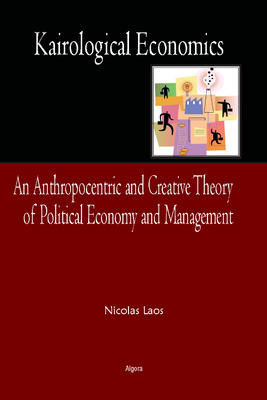
Kairological Economics

An Anthropocentric and Creative Theory of Political Economy and Management

Price range: $21.95 through $31.95

Economic analysis underpins and informs economic decision-making, even if there is a lengthy lag between economic analysis and its gradual absorption into economic debate.

Read More

Sound Bite

In this book Dr. Laos explores a revolutionary truth which is often silenced or ignored: There is a dynamic continuity between the structure of the world and the structure of consciousness. Hence, man is the architect of his history, and political economy is part of the reality that is created by the human being.In ancient Greek mythology, Kairos was the god of opportunity and an inspiring symbol of the method by which man can utilize and restructure reality according to his intentionality. This is the keystone of Kairological Economics, a new theory of economics and management.

About the Book

Economic analysis underpins and informs economic decision-making, even if there is a lengthy lag between economic analysis and its gradual absorption into economic debate. Once established as common sense, a text of economic analysis becomes incredibly powerful, because it delineates not only what is the object of knowledge but also what it is sensible to talk about or suggest. If one thinks and acts outside the framework of the dominant text of economic analysis, he risks more than simply the judgment that his recommendations are wrong; his entire moral attitude may be ridiculed or seen as dangerous just because his theoretical assumptions are deemed unrealistic. Therefore, defining common sense and, in essence, what is 'reality' and 'realistic' is the ultimate act of political power. Economic analysis does not simply explain or predict, it tells us what possibilities exist for human action and intervention; it defines both our explanatory possibilities and our moral and practical horizons. Hence, ontology and epistemology matter, and the stakes are far more considerable than at first sight seem to be the case.This is the main idea developed in the following chapters, as Dr. Laos leads readers through a pioneering way of looking at political economy.

Table content

PrefaceChapter 1: The Philosophical Underpinnings Of Economic Analysis And KairicityChapter 2: Economic LawsChapter 3: Communication Among Conscious Beings And The Dynamics Of The Economic SystemChapter 4: Economic AssumptionsChapter 5: Insufficient Economic Assumptions And The Problem Of UnemploymentChapter 6: Insufficient Economic Assumptions And The Problem Of InflationChapter 7: The Difficulties Of Refutation: The Development Of Knowledge In EconomicsChapter 8: Formal Methods Of Analysis In EconomicsChapter 9: Rationality And Economics: From Rationality To KairicityChapter 10: Efficient-Market Hypothesis, Behavioral Finance And Kairological FinanceChapter 11: Kairological Growth TheoryChapter 12: Kairicity, Distributive Justice And The Ethical Content Of EconomicsChapter 13: Kairology As A Research Program For Personal And Social AutonomyChapter 14: Kairicity And Network SocietyChapter 15: Institutions And Economic ActivityChapter 16: The Eurozone, Totemism And Democratic DeficitChapter 17: Philosophy Of History And Comparative EconomicsChapter 18: The Democratic Microstructures And Macrostructures Of Kairological EconomicsBibliographyIndex
About the Book

Most economics textbooks start from the assumption that human beings are rational actors making calculated decisions in predictable markets. Nicolas Laos thinks that framework is not just incomplete — it's fundamentally broken. In Kairological Economics, the Greek political and economic consultant draws on philosophy, history, and his work with academic institutions across the US and Europe to propose a genuinely new school of economic thought, one he names after Kairos, the ancient Greek god of opportunity.

The central argument is ambitious: mainstream economics has locked itself into outdated philosophical assumptions, ignoring the major advances in epistemology and ontology that reshaped the natural sciences during the twentieth century. Laos contends that economic analysis needs to account for the relationship between the world as a field of possibilities and human consciousness as a driver of intention and action. In other words, people don't just respond to economic reality — they help create it.

The book works through this idea systematically, tackling unemployment, inflation, the efficient-market hypothesis, behavioral finance, distributive justice, and the democratic deficits visible in institutions like the Eurozone. Along the way, Laos engages directly with major thinkers — Jeremy Bentham, John Stuart Mill, Adam Smith, Immanuel Kant, and John Maynard Keynes — showing where their frameworks fall short and what a kairological approach offers instead. He also addresses rational choice theory, network society, and the structures needed for genuine personal and social autonomy.

This is a challenging but rewarding read for anyone who suspects that conventional economic thinking leaves out something essential about what it means to be human.

Additional information

Weight N/A
Book Type Ebook, ePub, Hard cover, Soft cover
Pages

220

Release Year

BISAC I

POL046000 POLITICAL SCIENCE / Commentary & Opinion POL009000 POLITICAL SCIENCE / Comparative Politics

BISAC II

POL023000 POLITICAL SCIENCE / Political Economy

BISAC III

POL009000 POLITICAL SCIENCE / Comparative Politics

Reviews

There are no reviews yet.

Be the first to review “Kairological Economics”

Your email address will not be published. Required fields are marked *

Related books