About the author

Daniel N. Leeson

Daniel N. Leeson was bass clarinetist with the San Jose Symphony orchestra for twenty years and is an award-winning writer of nonfiction, including articles dealing with Mozart, published in the Mozart Jahrbuch, Music and Letters, The Instrumentalist, The Musical Times, Musical America, MadAminA, the International Journal of Musicology, Eighteenth Century Music, and The Newsletter of the Mozart Society of America. In addition, he has written program notes for the London Proms concerts, the San Francisco Symphony, San Francisco’s Midsummer Mozart Festival, and others. He is an editor of the Neue Mozart Ausgabe’s 120 volumes of Mozart’s music, and is an officer of the Mozart Society of America. Leeson has been an invited speaker at the Salzburg Mozarteum as part of the International Congress of Mozart scholars; at the Chautauqua Institute; the Nevada Mozart Festival; and the California Mozart Society in Carmel/Monterey. In 1992 and 1993, he was a faculty member of the Mozart Opera Studies Institute (San Francisco State University and California State University, Fresno).  Leeson’s fiction work, The Mozart Forgeries, was published in 2004.

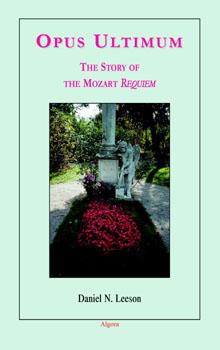
Opus Ultimum:

The Story of the Mozart Requiem

Price range: $22.95 through $28.95

The haunting beauty of Mozart’s Requiem and the tragic circumstances surrounding its composition have made it a favorite among performers and listeners alike. But how much of it is actually Mozart’s – and how do we know? Who wrote the missing pieces?

Read More

Sound Bite

The complex drama surrounding Mozart's final days and his noble Requiem is told here in a lyrical narrative style, relating the events that secretly transformed an incomplete musical blueprint for what was only a part of a composition into what is universally agreed to be one of humankind's greatest treasures.

About the Book

The haunting beauty of Mozart's Requiem and the tragic circumstances surrounding its composition have made it a favorite among performers and listeners alike. But how much of it is actually Mozart's - and how do we know? Who wrote the missing pieces? What role did his wife, Constanze, play - and what about the man who secretly commissioned the work? Who tricked whom, and who had the last laugh in this grim tale? The author, an internationally recognized expert on Mozart, traces the complex web of events and intrigue that produced the Requiem and miraculously preserved it for posterity. Here is an accurate, precise, complete narrative of the dramatic story, minus the difficult terms and musicological obscurities; with a spoonful of sugar, the author introduces some of the technical problems, clues, and terminology used in reconstructing such histories.

About the Book

Mozart died in December 1791 before finishing his Requiem in D minor, K. 626 — and the mystery of what he actually wrote, and what someone else completed, has fascinated music lovers for over two centuries. Daniel N. Leeson, a recognized Mozart scholar, tells the full story of this extraordinary piece in a way that reads more like a gripping narrative than a musicology textbook. No footnotes, no Köchel number breakdowns, no academic jargon — just the remarkable human drama behind the most famous unfinished composition in Western music.

The cast of characters is genuinely strange. There is Count Walsegg, the secretive aristocrat who commissioned the Requiem anonymously and intended to pass it off as his own work. There is Constanze, Mozart's widow, who fought fiercely to control the manuscript and its legacy. And there is Franz Xaver Süssmayr, the composer chosen to complete the work — whose contributions remain controversial to this day. Was he a plagiarist? A skilled collaborator working from Mozart's sketches? Or simply a lesser talent doing his best with impossible material?

Leeson works through these questions carefully, drawing on scraps of manuscript paper, conflicting accounts, and two centuries of scholarship. He also explores the broader drama: the reassembly of the manuscript, accusations of forgery, and what he calls a "festival of misfortunes" surrounding the Requiem's early history. Written for curious listeners rather than specialists, this is one of the most accessible and engaging accounts of a piece of music that still moves audiences around the world.

Additional information

Weight N/A
Book Type Ebook, Hard cover, Soft cover
Pages

188

Release Year

LC Classification

ML410.M9L274

Dewey code

782.32'38'dc22

BISAC I

REL055000

BISAC II

MUS020000

Reviews

There are no reviews yet.

Be the first to review “Opus Ultimum:”

Your email address will not be published. Required fields are marked *

Related books