


Sound Bite
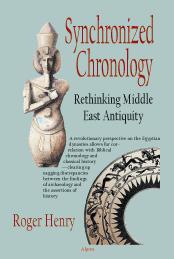
Imagine how distorted our understanding of ancient history would be if the chronological framework around which it was built had several extra centuries added. What if the backbone of Egyptian dynasties contained duplicates?A revolutionary perspective on the Egyptian dynasties allows for correlation with Biblical chronology and classical history - clearing up nagging discrepancies between the findings of archaeology and the assertions of history.
About the Book
The Bible, Egypt and ancient Greece do not line up. Roger Henry shows why, and how to fix it.
For generations historians have struggled to match Egyptian records with the Bible and Greek history. Dates clash, kings cannot be matched, and whole eras seem to vanish. Henry argues that the root cause is a flaw in Egyptian chronology itself: Manetho's ancient king lists contain duplicated dynasties that stretch the timeline by centuries.
Correct that error, he shows, and much falls into place. His Synchronized Chronology links the Exodus to the collapse of Egypt's Middle Kingdom, drawing on the Papyrus Ipuwer and the El Arish shrine text. It places Solomon alongside the Eighteenth Dynasty, reconsiders the identity of the Queen of Sheba, and rereads the Tell el-Amarna letters.
The book then outlines the history of the Middle East and Mediterranean from Abraham to Alexander the Great, with pharaohs and dynasties placed where archaeology supports them.
For readers of biblical history, Egyptology and ancient chronology who are ready to question the standard timeline.
Information
Synchronized Chronology: Rethinking Middle East Antiquity offers a bold rethinking of how Egypt, Israel, Greece, and Mesopotamia fit together in time. Drawing on Egyptian inscriptions, archaeological layers, classical writers, and the Hebrew Bible, Roger Henry argues that the standard Egyptian timeline is structurally flawed—containing duplicated dynasties and phantom centuries that throw the entire ancient Near Eastern chronology out of alignment.
Henry walks readers from the age of the Patriarchs and the Middle Bronze Age through the Exodus, Conquest, Judges, United Monarchy, divided kingdoms, Assyrian expansion, Neo-Babylonian power, and the Persian Empire. He correlates biblical events with Egyptian history, re-dates the 18th–20th dynasties, reinterprets the Hyksos, and connects the Tell el-Amarna letters to Israelite and Aramean kings. Along the way he reconsiders the Greek “Dark Ages,” the rise of Assyria, the nature of the “Hittite Empire,” and the famous Battle of Carchemish, proposing new identifications for well-known pharaohs, including Ramses II.
Readers will find detailed discussions of key sites such as Jericho, Shechem, Samaria, and Tell el-Dab’a, as well as treatment of alphabet origins, the Sea Peoples, and the transmission of scripts and culture across the eastern Mediterranean.
This book will appeal to:
- Students and enthusiasts of ancient Near Eastern history
- Readers interested in biblical history and archaeology
- Scholars and lay researchers curious about alternative chronologies
- Those following the works of Immanuel Velikovsky, Peter James, and David Rohl
- Anyone intrigued by how a single chronological shift can reshape the stories of Egypt, Israel, Greece, and Mesopotamia
Henry offers a coherent, cross-disciplinary framework that invites readers to reconsider long-held assumptions about the ancient world.




Reviews
There are no reviews yet.