


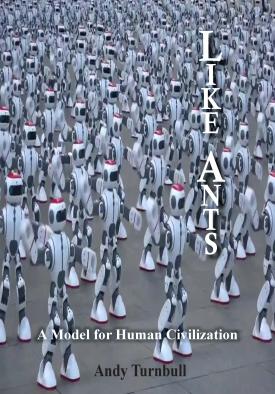


Sound Bite
Countering popular beliefs, Andy Turnbull offers an alternative view of the development of civilization based on Jane Jacobs' scenario and E.O. Wilson's belief that we are an eusocial species, valuing cooperation and teamwork above individual initiative.
About the Book
In Like Ants: A Model for Human Civilization?, Andy Turnbull embarks on an enlightening consideration of humanity’s survival, evolution, and the lessons we can learn from the fascinating world of ants. Combining thought-provoking research, biological comparisons, and philosophical inquiry, this book delves into the parallels and contrasts between human societies and ant colonies, challenging conventional wisdom about the foundations of civilization and cooperation.
The Longevity of Ants vs. Humanity’s Fragility:
Ants have thrived for over 100 million years, while humanity, a relatively young species, has endured for just one million. Turnbull examines the evolutionary success of ants, exploring their highly cooperative behaviors, intricate social systems, and resource management strategies. By studying these small yet mighty creatures, the author raises profound questions about whether humans can adopt—or have already gone too far in adopting—ant-like organizational principles.
The Power of Cooperation:
Central to Turnbull’s thesis is the argument that cooperation has been the cornerstone of humanity’s survival and progress. From early hunter-gatherer societies to modern civilizations, Turnbull highlights how collaboration and mutual support have allowed humans to overcome immense challenges. However, he juxtaposes this with the hyper-specialized and hierarchical organization of ant colonies, sparking a critical discussion: Is there a limit to how much we should emulate the collective behaviors of ants without losing our individuality?
Lessons from Ant Societies:
Turnbull dissects various aspects of ant colonies, including their division of labor, communication methods, and environmental adaptability, comparing them to human practices in urban planning, resource distribution, and conflict resolution. The book invites readers to consider whether humanity can refine its systems by adopting ant-like efficiency, or whether such mimicry could lead to unintended consequences, such as loss of autonomy and creativity.
Ethical and Philosophical Implications:
At its core, Like Ants addresses the philosophical question of balance: How much should humanity prioritize the collective over the individual? Turnbull navigates the ethical complexities of modeling human civilization on ant societies, emphasizing the importance of preserving humanity’s unique capacity for empathy, innovation, and individuality.
Turnbull urges readers to reflect on the trajectory of human civilization and to consider how lessons from nature could guide sustainable and ethical societal development. Whether you are a biologist, anthropologist, environmentalist, or philosopher, this book will captivate your imagination and deepen your understanding of what it means to be human.



Reviews
There are no reviews yet.